
What is Jev? TypeSafe's new AI model.
Jev is an AI model that picks answers instead of writing them. It launched on September 15, 2026. This covers what it is in plain terms, how it compares to ChatGPT, Claude, and Claude Code, why engineers got loud about it, and what the independent tests show so far.


The short answer
Jev is an AI model that makes decisions instead of writing. You give it some information and a question with fixed answer choices, and it picks an answer and tells you how sure it is. It cannot write a sentence.
Ask ChatGPT whether an email is a refund request and it writes back a paragraph. Ask Jev the same question with the choices "refund, billing, or cancel" and it returns something like "refund, 91% sure." One is an essay answer. The other is a multiple-choice answer with a confidence score attached.
That is less than a chatbot does, on purpose. What Jev trades away in flexibility it gets back in speed and price. TypeSafe AI, the company that makes it, reports answers in 70 to 500 milliseconds and charges $0.042 per million input tokens (a token is roughly three-quarters of a word), with nothing charged for the answer.
Jev is not an app you chat with. Developers build it into their own software, where it makes the same small call thousands of times a day: sorting support tickets, flagging risky ad copy, scoring sales leads. TypeSafe launched it in early access on September 15, 2026, and opened it to everyone on September 20.
How Jev compares to ChatGPT, Claude, and Claude Code
ChatGPT and Claude write, and Claude Code writes and runs software. Jev sorts, which puts it closer to the spam filter in your inbox than to any of them.
ChatGPT and Claude are chat assistants built on large language models. They read what you type and write a reply one word at a time, so they can explain, draft, summarize, and reason through a problem where you can see it. That flexibility costs time and money on every question, and it leaves you with a paragraph that a person, or more code, has to turn into a decision.
Claude Code is Anthropic's coding agent. You give it a task and it reads your files, writes code, runs commands, and checks its own work over many steps. Jev can do none of that, because it cannot write. The two can work together, though: Alex Volkov used a Jev plugin to shrink a long Claude session from nearly 1M tokens to 86K in about a second, a demo covered below.
A spam filter is the closest thing most people already use. It sorts one kind of message into fixed buckets and was trained for that single job. Jev sorts almost any text into buckets you define on the spot, without training a model for each job, and gives every bucket a probability.
| ChatGPT, Claude | Claude Code | Jev | |
|---|---|---|---|
| What it is | A chat assistant | A coding agent | A decision model |
| Who uses it | Anyone | Developers | Developers, inside their products |
| You give it | A message | A task and a codebase | Data, plus questions with fixed answer choices |
| You get back | Written text | Code changes and commands | One of your choices, with a probability |
| Explains itself | Yes, in words | Yes, in words | No |
| Best for | Drafting, explaining, reasoning | Building and fixing software | Sorting, scoring, and checking at high volume |
You can ask the models behind ChatGPT or Claude to do Jev's job today: give them the email and the three choices, and they will pick one. You get a written answer you have to trust or parse, at chat-model speed and price. Jev's pitch is doing that one job faster, cheaper, and with a probability you can set thresholds on, such as "send anything under 70% to a person." Whether that is worth switching for is most of the debate covered below.
How Jev works
TypeSafe calls Jev a "System One" model, after Daniel Kahneman's term for fast, intuitive thinking. In that framing a chat model is System Two, reasoning out loud one token at a time, and Jev answers without that step.
A call has two parts. The state is whatever your application knows, sent as a string, a JSON object, or an array: a support ticket, a search result, a lead record. The questions are typed. TypeSafe's documentation says the model reads the state once and evaluates every question against it in parallel, rather than generating an answer token by token. There are three question types.

Choice
Pick one of up to 255 labelled options. Jev returns the chosen key, a probability for every option, and a confidence value. Routing, triage, and tagging are Choice questions.

Score
Place the state on an ordered rubric of 2 to 10 levels. Jev returns a score that can land between levels, plus the probability of each level. Lead scoring and quality grading are Score questions.

Noul
The probability, from 0 to 1, that a statement about the state is true. Near 1 is a strong yes and near 0 a strong no. Near 0.5 means the model is unsure, not that the answer is "medium."
Here is the Team question from the example above as the API sees it, trimmed from TypeSafe's API reference to one of its three questions. You send the state and the answer options:
POST https://api.typesafe.ai/v1/systemone
{
  "model": "jev-latest",
  "state": "Help! My payouts have been failing for 3 days.",
  "questions": {
    "department": {
      "type": "choice",
      "instructions": "Which team should handle this?",
      "criteria": {
        "billing": "Payments, invoicing, refunds",
        "technical": "Bugs, outages, integrations",
        "sales": "Pricing, upgrades, new accounts"
      }
    }
  }
}
You get back a pick, a probability for every option, and a confidence value:
{
  "model": "jev-1.13.0",
  "answers": {
    "department": {
      "type": "choice",
      "choice": "billing",
      "probabilities": { "billing": 0.88, "technical": 0.12, "sales": 0.0 },
      "confidence": 0.81
    }
  }
}
TypeSafe trained Jev with a method it calls Reinforcement Learning for Calibrated Decisions (RLCD). Calibration means that across many answers where Jev says 0.8, it should be right about 80% of the time. That is a claim about groups of predictions. It says nothing certain about any single answer.
Developers reach Jev through TypeSafe's own API, where the current version is jev-1.13.0, or through Vercel AI Gateway, Cloudflare, and OpenRouter. TypeSafe's documentation allows 64k tokens per request (32k of data plus the longest question), while Vercel and OpenRouter list 32K, so check the limit on the route you use.
The company spent about two years in stealth and raised a $40M seed round led by DCVC, SiliconANGLE reported. Forbes put the valuation at about $200M, citing a person familiar with the deal; TypeSafe has not published one. Founder and CEO Diogo Almeida worked at OpenAI on reinforcement learning from human feedback, InstructGPT, ChatGPT, and GPT-4. His co-founders are CTO Erik Gafni and COO Sasha Sheng.
Why the hype
Three things landed in the same week: a price close to zero, answers in under a second, and demos from people developers already follow.
Attention came first. Almeida's launch post on X passed 38 million views within a week, and TypeSafe's post ending the waitlist on September 20 drew another 1.4 million. Vercel reports Jev as the fastest-adopted model in AI Gateway history: nearly 13% of paid teams used it within 24 hours, about twice the share the GPT-5.6 family reached and more than six times Fable 5.1's. Those are Vercel's figures from its own gateway, and Vercel sells access to the model.
The demos that spread fastest:
- A safety reviewer. Vercel CEO Guillermo Rauch reported that Jev, tested as the safety reviewer in
fx, was "up to 18x faster (p95) and more accurate" than the model doing that job. - Context compaction. Alex Volkov ran Tamara Tran's compaction plugin and reported it cut his Claude session from nearly 1M tokens to 86K in about a second.
- A browser agent. Browser Use co-founder Gregor Zunic reported a flight search that took 7 seconds and cost $0.0039.
- Bulk labelling. Hassan El Mghari classified 1,018 AI research papers into 24 topics for $0.08 in total, at a median of 256 milliseconds per call.
Each is a single run by the person who built it, which shows what a good day looks like but is not a benchmark.
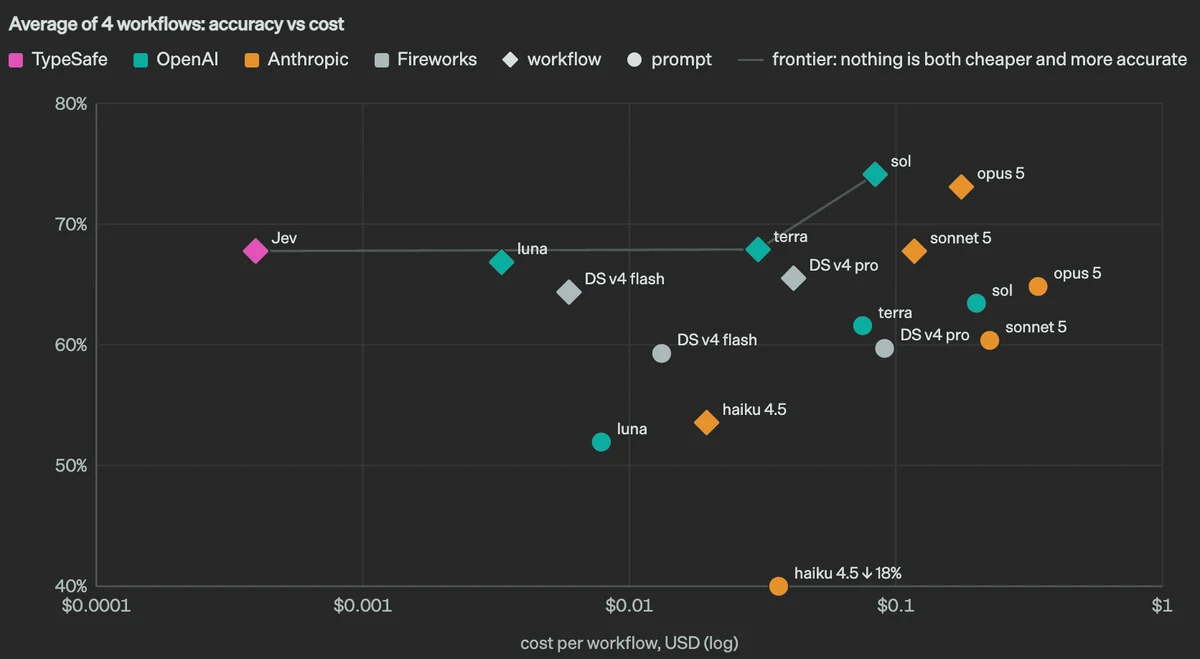
The speed and cost multiples are where the numbers drift. TypeSafe's press release says "up to 100 times" faster and less expensive. Its launch post reports 193.6x faster and about 445x cheaper on its internal workflow evaluations. LangChain's post says 200x faster inference and 400x lower cost. That is three sets of figures in one week, and all of them trace back to TypeSafe's own testing. TypeSafe also chose not to publish results on public benchmarks and tells users to build evaluations on their own data. For a decision model that is a reasonable position. It also means no outside party can reproduce the headline multiples yet.
The pushback was just as loud. Nathan Flurry's post calling Jev "just a really smart switch statement" became one of the most shared reactions of launch week. On Hacker News, when a commenter described Jev as "basically a zero-shot classifier," Almeida replied "exactly right!" The compaction demo drew the sharpest critique: Theo Browne called it "a terrible compaction strategy," arguing that Jev judges each step of a session without seeing what that step returned. The argument is about whether calibration and price make an old idea worth switching to.
Open-source copies arrived within days. openjev-sglang serves a Jev-compatible API from an open Qwen model, Bespoke Nimble publishes the data and recipe for an open version built on Qwen3.5-9B, and Convai's Laya pitches itself as a faster, multilingual alternative you can run yourself.
What Jev is for
Jev fits anywhere software makes the same bounded decision many times a day, and a slow or expensive answer costs more than an occasional wrong one.
- Routing. Send each request to the right model, queue, or agent tool.
- Support triage. Category, urgency, and whether a person needs to see it now.
- Search filtering. In a chatbot that looks things up before it answers (a setup called RAG), check whether each passage it found actually answers the question before the chatbot writes its reply.
- Checks on other models. Whether a citation supports its claim, whether an output breaks a policy, whether an extracted field matches its source.
- Agent loops. The small "continue, retry, or stop" decisions an agent makes dozens of times per task.
TypeSafe's own use-case map has sections for advertising and lead generation. The jobs we would test first:
- Search-term negatives. Read the search terms report and flag the queries to exclude, with a probability you can set a threshold on.
- Creative tagging. Label every ad by hook, format, offer, and claim, so performance can be grouped by what the ad says.
- Claim and brand-safety checks. Flag regulated claims in fintech, health, or crypto copy before it ships, for a person to approve.
- Ad-to-page match. Check whether the landing page delivers what the ad promised.
- Lead scoring and routing. Score inbound leads against an ideal-customer rubric and route them to the right rep.
- Content QA and internal links. Gate drafts on a checklist and suggest which pages should link to which.
How well any of these works depends more on how you write the questions than on the model. The phishing test below puts a number on it.
What is proven and what is still a claim
Three independent tests were published within days of launch. They are more useful than the launch material, and each comes with caveats its author wrote.
| Claim | Source | Status |
|---|---|---|
| 70 to 500 ms per call | TypeSafe | Vendor-reported. One independent test measured 0.533 s mean per message, including retrieval and network time. |
| 100x to 445x faster or cheaper | TypeSafe, LangChain | Vendor-reported, inconsistent between sources, no public benchmark. |
| Fastest-adopted gateway model | Vercel | The platform's own usage data. |
| Near fine-tuned accuracy | Independent | 92.40% on BANKING77 vs. 93.66% for a published fine-tuned BERT, with retrieved examples. |
| Beats zero-shot BERT models | Independent | Won on all seven evaluation sets against a clean zero-shot baseline. |
| Calibrated probabilities | TypeSafe | No public independent calibration test that we found. |
Close to a fine-tuned model on banking intents
GitHub user simonmesmith ran jev-1.13.0 on the 3,080 test messages of BANKING77, a public dataset of banking customer messages sorted into 77 intents. Jev scored 92.40% (2,846 of 3,080). A fine-tuned BERT model published by Casanueva et al. in 2020 scored 93.66%. Macro-F1 was 0.9235, the mean time per message was 0.533 seconds and the p95 was 0.713 seconds, both including retrieval and network time, and the experiment cost $0.7671 in API calls. The author lists the caveats up front. This was not zero-shot: each message came with 24 similar labelled examples retrieved by BM25 search, plus definitions for all 77 intents. BANKING77 is public, so it may sit in Jev's training data, and nobody has audited that. The BERT figure is a published number, not a rerun.
Ahead of zero-shot BERT models
A second project, by GitHub user zhuyansen, compared Jev with BERT-family zero-shot classifiers on seven evaluation sets. Jev won on all seven, by 0.05 to 0.13 accuracy on the standard benchmarks. On AG News it scored 0.865 against 0.763 for a clean DeBERTa zero-shot model. The most useful result is on 258 arXiv papers submitted after Jev's release, which cannot be in its training data: Jev led by 0.30 accuracy. On PAWS, a paraphrase set, the gain was 0.03 AUC. The caveats: against bge-m3 embeddings Jev was a statistical tie on Banking77 (0.712 vs. 0.722), bare label names cost it 0.13 on Banking77, and the post-release set is small and uneven across topics.
Question design decides the result
The most practical finding so far comes from XenoSpectrum, which ran Jev on 2,000 emails to detect phishing. Asked as a single question, "Is this email phishing?", Jev scored 62.6%. Split into five narrower questions and combined, it scored 89.4%. With the five answers weighted by a logistic regression fitted on half the emails, it scored 95.0%. Same model, same emails, and a 32.4-point spread that came entirely from how the questions were written. The 95.0% was not a statistically significant improvement on Haiku's 93.2% on the same task.
With Jev, writing the questions is most of the work of building the classifier. Budget time for question design and for a test set drawn from your own data, which is what TypeSafe tells users to do anyway.
Where Jev does not fit
Jev picks answers from options you define. It does not explain its choice, write text, or read images.
- No audit trail. There is no chain of thought, no "why" string, and no feature attribution. If a customer or regulator asks why a lead was rejected, Jev's output alone will not answer them.
- Text only. No images, audio, or video. Tagging ad creative means transcribing or describing it first.
- English first. TypeSafe says other languages work, with lower quality.
- Known weak spots. TypeSafe's notes on jev-1.13 list numbers, dates, and reading wording too literally.
- Calibration describes averages. A 0.9 is right about nine times in ten across many answers. Any single 0.9 can still be wrong.
- It is not a control. Jev does not replace authorization, deterministic validation, or human review. Use it to triage and filter, and keep a person or a hard rule on anything with legal, financial, or safety consequences.
- It does not generate. If the output is prose, code, or a reply, use a language model. Jev can sit in front of one and decide when it runs.
22 sources




Frequently asked questions
What is Jev?
Jev is an AI model from TypeSafe AI that makes decisions instead of writing text. You give it information and a question with fixed answer choices, and it returns one of the choices with a probability showing how sure it is. TypeSafe launched it in early access on September 15, 2026, and opened it to everyone on September 20.
How is Jev different from ChatGPT or Claude?
ChatGPT and Claude write replies and can explain their reasoning. Jev cannot write at all. It picks from answer choices you define and gives a probability, which makes it faster and cheaper for high-volume sorting, scoring, and checking, and the wrong tool for anything that needs written output.
Can I use Jev like ChatGPT?
Not in the way you use ChatGPT. Jev is built for software to call, not for conversation. Developers reach it through TypeSafe's API and SDKs, Vercel AI Gateway, Cloudflare, and OpenRouter, and build it into their own products.
How much does Jev cost?
TypeSafe prices jev-1.13.0 at $0.042 per million input tokens, and output is free. A token is roughly three-quarters of a word.
Can Jev hallucinate?
It cannot invent an answer outside the options you define, because it does not generate text. It can still pick the wrong option, and it gives no explanation for its choice, so high-stakes decisions still need validation and human review.
Putting a model like Jev to work?
Growthr's AI consulting team designs and ships decision layers for marketing: lead scoring, creative tagging, and claim checks, tested on your own data before anything goes live.
Related: AI consulting · How to get ChatGPT to recommend your business · Does llms.txt work?